
Introduction
ost opportunities — often without the business owner even realizing it.
Understanding the true cost of slow response times is the falmost immediately.
This expectation has been shaped by the rise of digital communication. Online services, messaging platforms, and instant customer support have conditioned people to expect rapid replies.
For businesses that cannot rIn today’s business environment, speed matters.
Customers expect quick answers when they contact a company. Whether they are calling, sending a message, or submitting a form online, most people expect some type of response espond quickly, this creates a serious challenge.
Slow response times can quietly cost companies thousands of dollars in lirst step toward improving communication systems and capturing more business opportunities.
Why Response Speed Matters More Than Ever
If one business does not respond quickly, the next option is only a few clicks away.
Because of this, response speed has become one of the most powerful factors influencing customer decisions.
The company that responds first often becomes the company that earns the customer.
The First-Response Advantage
Studies across multiple industries consistently show a strong correlation between response speed and lead conversion.
When businesses respond quickly to inquiries, several things happen:
• customers feel acknowledged
• trust begins to form immediately
• conversations move forward faster
• competitors lose the opportunity to step in
On the other hand, when responses are delayed, customers often assume one of the following:
• the business is too busy
• the business is disorganized
• the business may not value new customers
Even if these assumptions are incorrect, they can still influence customer decisions.
As a result, slow response times can dramatically reduce the number of leads that turn into actual customers.
The Hidden Revenue Loss
The financial impact of slowresponse times is often invisible.
Many business owners assume that if a customer truly wants their service, they will leave a message or try again later.
But in reality, many customers do not follow up.
Instead, they simply contact another company.
Consider a simple example.
A business receives 100 inquiries per month through phone calls, website forms, and messages.
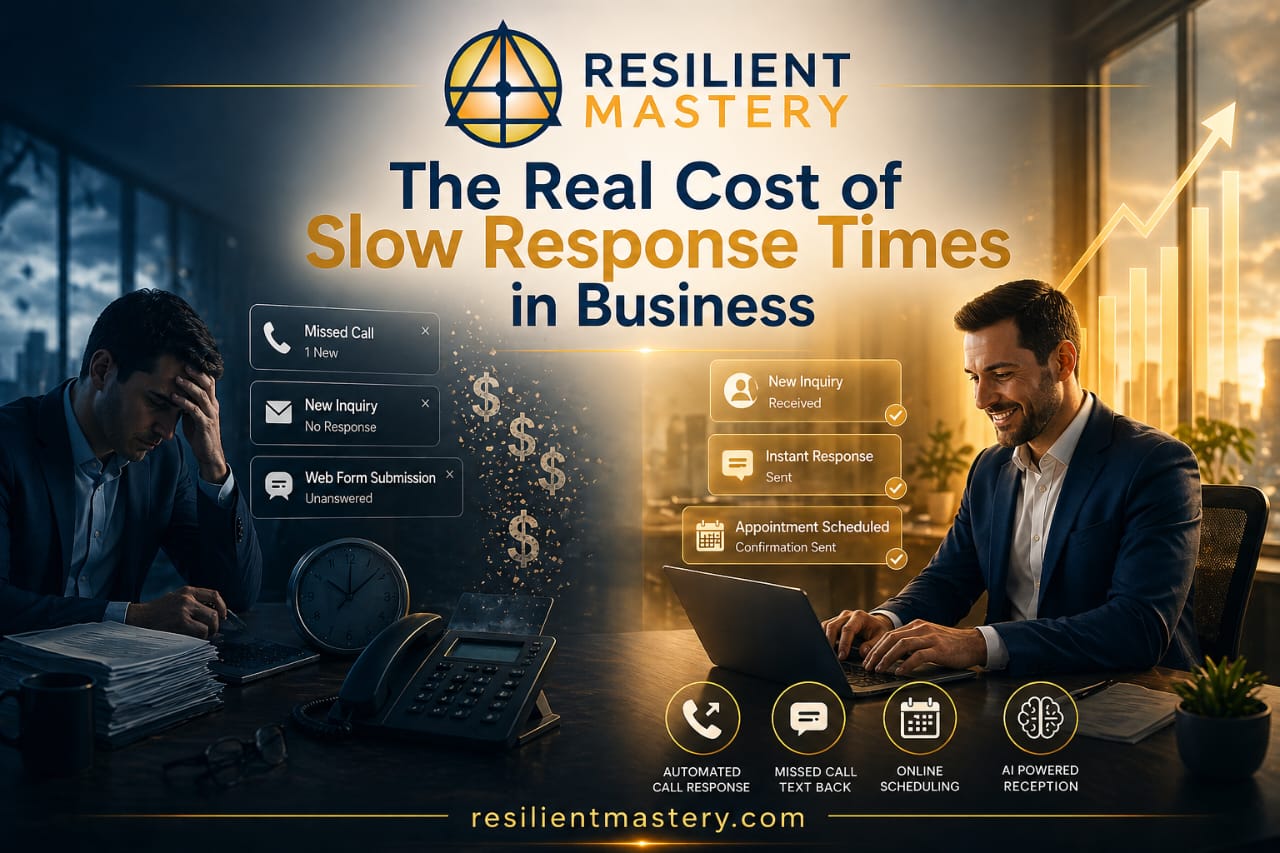
If 25 percent of those inquiries receive slow responses or no response at all, that means 25 opportunities may disappear before a conversation even begins.
If each potential customer represents a few hundred dollars — or even thousands in some industries — the lost revenue can add up quickly.
This loss often happens quietly in the background, making it difficult for businesses to recognize the scale of the problem.
Why Slow Responses Happen
Most businesses do not respond slowly on purpose.
In fact, many teams work extremely hard to provide excellent service.
However, modern business operations create several challenges:
High call volume
Multiple communication channels
Limited staff availability
Busy service schedules
Administrative workload
Front desk teams, customer service staff, and managers often juggle multiple responsibilities at the same time.
When several inquiries arrive simultaneously, delays can easily occur.
These delays are not a result of poor intentions — they are usually the result of operational limitations.
The Impact on Customer Experience
Slow response times do more than affect revenue.
They also influence how customers perceive a business.
When people contact a company, they are often looking for reassurance that they will be taken care of.
Quick responses signal professionalism and reliability.
Slow responses can create uncertainty.
Even if the business eventually replies, the initial delay may leave a negative impression.
Over time, consistent responsiveness becomes a key part of building a strong reputation.
Businesses that communicate quickly often develop stronger relationships with customers and generate more positive reviews.
The Operational Bottleneck
Many businesses rely on manual systems for handling inquiries.
Calls must be answered by staff.
Messages must be reviewed manually.
Appointments must be scheduled individually.
While these methods have worked for many years, they can struggle under higher communication volumes.
As businesses grow, these systems can become bottlenecks that slow down response times.
The result is a growing gap between customer expectations and a company’s ability to respond.
Modern Tools That Improve Response Speed
Fortunately, modern communication systems offer ways to reduce these delays.
Businesses are increasingly adopting tools that help them respond faster to inquiries, including:
automated call response systems
missed-call text messaging
online scheduling tools
chat automation
AI reception systems
These technologies help businesses respond instantly to initial inquiries while still allowing human teams to handle more complex interactions.
Instead of replacing staff, these systems help teams manage communication more efficiently.
Creating a Faster Communication System
Improving response speed does not require completely restructuring a business.
Often, it simply involves adding systems that support existing workflows.
For example:
A missed call can automatically trigger a text message.
A website visitor can instantly see available appointment times.
An incoming inquiry can be routed to the appropriate team member automatically.
These small improvements can dramatically reduce response delays and help businesses capture more opportunities.
Larne More: LinkedIn
The Competitive Advantage of Responsiveness
Businesses that respond quickly often stand out in crowded markets.
Customers notice when communication is smooth and efficient.
When a company responds immediately, it sends a clear signal that the business is organized and attentive.
Over time, this responsiveness can become a powerful competitive advantage.
Businesses that prioritize communication systems often experience:
higher conversion rates
improved customer satisfaction
more consistent lead capture
stronger long-term growth
Final Thoughts
Slow response times are one of the most common — and most overlooked — problems in business communication.
When inquiries go unanswered or responses take too long, opportunities quietly disappear.
The good news is that modern communication tools make it easier than ever to improve responsiveness.
By strengthening communication systems and reducing response delays, businesses can capture more opportunities and create better experiences for their customers.
If you want to learn more about how modern communication systems are helping businesses respond faster and capture more opportunities, visit: